Monday, August 17, 2026

Sasquatch Stick Structures: Tree Breaks, Arches, X-Marks, Nests & Other Forest Signs

Sasquatch Stick Structures: Tree Breaks, Arches, X-Marks, Nests & Other Forest Signs


By JM Talboo DebunkerBusters.blogspot.com

When people talk about Bigfoot evidence, footprints, eyewitness reports, photographs, and recordings usually get most of the attention. One category of reported evidence, however, is much less familiar to the general public: stick and tree structures.

These formations include broken or twisted trees, bent saplings, arches, X-shaped arrangements, teepee-like structures, woven branches, lean-tos, shelters, and larger configurations sometimes described as “super structures.” Some researchers believe these formations are deliberately created by Sasquatch. Others argue that many can be explained by wind, snow, falling trees, animals, or human activity.

That disagreement is important.

A responsible investigator shouldn't look at every strange arrangement in the woods and immediately declare that Bigfoot built it. At the same time, automatically dismissing every unusual structure as meaningless natural debris isn't investigation either.

The real question is whether there are recurring patterns—and whether some examples occur under circumstances that make ordinary explanations less convincing.

The 2026 Idaho Case: A Tree Break Adds Another Clue

This question became particularly interesting following a Memorial Day weekend 2026 Bigfoot investigation in the Payette National Forest near McCall, Idaho.

The original incident involved multiple witnesses who reported seeing a large, dark, upright figure during a camping trip approximately 16 miles northwest of McCall.

A subsequent development was reported in the August 2026 issue of Bigfoot Times.

Laura Cransman, whose family has longstanding connections to the area, was there approximately ten days after the original incident. Her mother's side of the family had homesteaded in the area during the 1800s.

While there, she noticed an unusual broken tree approximately 8–10 inches in diameter. The tree appeared to be in good health, but it had been broken and partially twisted.

Cransman initially drove past it, then doubled back to take another look.

Was it the work of Bigfoot?

We don't know.

And that's precisely why it is interesting.

The same Bigfoot Times follow-up also reports impressions in the ground that could potentially have been footprints, although Cransman appropriately acknowledged that, as an untrained observer, she couldn't confidently identify every unusual impression.

The original witnesses' story was investigated further. Cliff Barackman of the North American Bigfoot Center participated in a Zoom discussion with Matt Moneymaker of the Bigfoot Field Researchers Organization concerning the incident. The discussion was incorporated into Episode 373 of Bigfoot and Beyond with Cliff and Bobo.

Jonathan Easley of Western Bigfoot Exploration also conducted an on-site investigation. After examining the circumstances and speaking with the witnesses, Easley described the account as plausible and said he believed the events really occurred.

One witness described seeing a tall, black figure approximately 7–8 feet tall directly behind the tent, roughly ten feet away.

None of this independently establishes what the witnesses saw.

But a multiple-witness report followed by an on-site investigation, possible track impressions, and an unusual tree break in the same general area certainly gives investigators something to document.

For the complete Idaho investigation and the additional material surrounding the sighting, see:

https://undebunkingbigfoot.blogspot.com/2026/08/nine-feet-in-idaho-forest-examining.html?m=1

That Idaho investigation is also relevant to the subject of stick structures because the tree break demonstrates exactly why these observations need to be documented rather than simply dismissed—or immediately attributed to Sasquatch.

What Are Sasquatch Stick Structures?

Researchers use the term “stick structure” rather broadly.

Reported formations include:

  • X structures — branches or trees arranged in an X pattern

  • Arches — saplings bent over and held down or supported by another tree, branch, or rock

  • Teepee structures — multiple branches or logs arranged in a conical formation

  • Lean-tos and shelters — branches placed against trees or fallen logs

  • Asterisk formations — several branches arranged radially

  • Woven structures — branches interlaced with one another

  • Tree breaks — trees or saplings broken and sometimes twisted at the break

  • Balanced logs and branches — material positioned between trees or suspended above the ground

  • Nests or beds — larger arrangements of vegetation interpreted by some researchers as resting places

The Nox Gigas Study provides one of the more extensive attempts to categorize these formations, describing arches, X structures, stick clusters, teepees, lean-tos, tree breaks, balanced logs, and larger “super structures.”

https://sites.google.com/site/noxgigasstudy/sasquatch-tree-and-stick-structures

The researcher presents interpretations of some structures as hypotheses rather than established facts and emphasizes examining the surrounding environment.

That distinction matters.

A photograph of an unusual arrangement is an observation.

The claim that Sasquatch made it is an interpretation.

Those should never be confused.

Tree Breaks: One of the More Interesting Signs

Tree breaks deserve special attention because they are different from simply finding branches lying on the ground.

Some researchers report trees that appear to have been deliberately broken, twisted, bent, or pushed into unusual positions.

The Nox Gigas material describes tree breaks and emphasizes comparing potentially unusual formations with natural and human causes. If numerous nearby trees show comparable damage in the same direction, for example, wind becomes an obvious alternative explanation.

https://sites.google.com/site/noxgigasstudy/sasquatch-tree-and-stick-structures

That's exactly the sort of procedure that should be used.

Look at the break itself.

Is it a clean snap? Is it twisted? Is the wood splintered?

Look at the surrounding forest.

Are other trees damaged in the same direction?

Look at the location.

Is it beside a road, trail, campsite, logging area, or other place where people could easily have manipulated it?

And most importantly, look for associated evidence.

Are there tracks, impressions, hair, disturbed vegetation, additional breaks, structures, vocalizations, or other unusual observations nearby?

A single broken tree is one thing.

A broken tree accompanied by multiple independent signs is another.

I Tried Building One Myself

There's another experiment worth mentioning because it addresses a question that is often overlooked:

How difficult is it actually to build one of these structures?

I've done it myself.

I went into the woods and deliberately attempted to construct a large, teepee-like stick structure comparable to the kinds of structures I've seen photographed in Bigfoot research.

It took me approximately 45 minutes of sustained work to produce one that I considered reasonably comparable to those examples.

And that was with me intentionally building it.

I had to find suitable branches, position them, balance them, adjust them, and repeatedly reposition pieces until the structure held together and looked coherent.

If you've never attempted it yourself, it is easy to underestimate how much work goes into producing a substantial, organized structure.

My experiment obviously does not prove that any particular structure found in the woods was constructed by Sasquatch.

It does demonstrate something useful, however:

Building a substantial, coherent stick structure takes deliberate manipulation and physical effort.

That gives investigators another question to ask when examining structures in the field:

Does the arrangement actually look like something that could have resulted from the ordinary processes occurring in that particular forest?

And if someone argues that a particular formation was created naturally, there should be a plausible mechanism that explains how it got there.

That's where firsthand experimentation becomes valuable.

Instead of merely looking at photographs and arguing about whether something looks artificial, researchers can go into the woods and try to reproduce it.

I've now done that with one type of structure.

And my conclusion was simple:

It takes some damn work.

Don't Leave Your Experiment Behind

There's one other important part of my experiment that researchers should keep in mind.

I destroyed the structure before I left.

If you're going to deliberately construct a Bigfoot-style structure as an experiment, don't simply walk away and leave it sitting in the woods.

Someone else could find it later without knowing who built it. They could photograph it, document it, report it as unexplained, and unintentionally add a completely artificial piece of evidence to the body of material that future researchers are trying to evaluate.

That's the last thing we need.

Anyone conducting an experiment like this should dismantle the structure completely or otherwise make its artificial origin unmistakable before leaving the area.

The goal of field research should be to reduce ambiguity, not create more of it.

I built mine to see what it took.

I documented what I learned.

And then I took it apart.

That's how a field experiment should be done.

Other Tree Breaks and Structures

The idea of unusual tree manipulation isn't limited to one location.

Bigfoot researchers have reported:

  • saplings bent into arches

  • branches twisted together

  • trees pushed over and positioned against others

  • crossed branches

  • branches balanced unnaturally between trees

  • trees positioned over waterways or obstacles

  • large arrangements involving multiple trees

  • woven branches that appear deliberately interlocked

The Nox Gigas material documents structures from multiple regions and emphasizes the importance of distinguishing potentially unusual formations from natural and human causes.

https://sites.google.com/site/noxgigasstudy/sasquatch-tree-and-stick-structures

Your own existing page on the subject can also serve as a photographic reference:

Bigfoot Stick Structures

https://undebunkingbigfoot.blogspot.com/2021/01/bigfoot-stick-structures.html?m=1

That page currently consists primarily of a screenshot from a book, but it still provides another reference point for the discussion.

Nests: When Stick Structures Become Something More

One particularly interesting category is the alleged Sasquatch nest.

Reports describe large circular or oval structures made from branches, sticks, leaves, grass, and other vegetation. Some researchers interpret these as sleeping or resting areas.

Hangar 1 Publishing discusses purported Sasquatch nests, including structures described as having interwoven branches and central body-sized depressions. The article also discusses other signs sometimes reported in association with these structures.

https://hangar1publishing.com/blogs/cryptids/bigfoot-nest

There is an obvious comparison with known primates.

Great apes build nests. Gorillas and chimpanzees construct resting structures from vegetation, demonstrating that nest-building itself is not beyond the behavioral capabilities of a large primate.

That does not establish that Sasquatch builds the reported structures.

It does, however, explain why the possibility is worth investigating if the structures can be authenticated.

The central problem remains that researchers generally lack direct, universally accepted footage of a Sasquatch constructing or using one of these alleged nests. Without that direct observation, attribution remains circumstantial.

What About Natural Explanations?

There are plenty.

Trees fall.

Branches become wedged together.

Snow and ice bend vegetation.

Wind creates spectacular formations.

Animals manipulate vegetation.

Bears construct beds.

Humans build shelters, hunting blinds, trail markers, and other structures.

Even several natural processes occurring together can occasionally produce something that looks remarkably deliberate.

That's why experienced investigators should examine the entire scene.

The Bigfoot community itself has had this debate for years.

In a Reddit discussion devoted specifically to stick structures, participants debated whether researchers were adequately documenting these formations and whether natural and human explanations were being properly considered.

https://www.reddit.com/r/bigfoot/comments/p7kwm7/stick_structures_why_are_researchers_just_posting/

A separate Bigfoot Forums discussion is explicitly titled “Stick Structures Are Not Evidence,” although the thread itself contains arguments on both sides.

https://bigfootforums.com/topic/66924-stick-structures-are-not-evidence/

That's actually encouraging.

Why?

Because it demonstrates that Bigfoot researchers themselves don't universally accept these formations as evidence.

They're arguing about them.

That's what investigation is supposed to look like.

The “Don't Just Photograph It” Problem

One of the best principles to emerge from the debate is simple:

Document the hell out of it.

If you find a potential structure, record:

  • GPS coordinates

  • date and time

  • photographs from multiple angles

  • measurements

  • height and diameter of branches

  • orientation

  • surrounding terrain

  • nearby trails

  • water sources

  • animal tracks

  • broken trees nearby

  • signs of human activity

  • possible wind or weather damage

  • vegetation type

  • similar structures in the immediate area

Then photograph the surrounding forest—not just the interesting object.

A single photograph can be misleading.

A complete site investigation is much harder to dismiss.

Field Guides: Yes, There Are Books for This

If you're serious about looking for structures, you don't have to rely exclusively on internet photographs.

Jeff Meldrum's Field Guide to Bigfoot, Yeti, and Other Mystery Primates Worldwide includes a section dealing with stacked rocks, tree breaks, and nests.

The guide describes broken branches or saplings twisted back on themselves as potential Sasquatch sign while explicitly warning investigators to consider explanations such as elk or moose rubbing, snowpack, and avalanche damage.

It also recommends looking for associated evidence such as impressions and hair.

That's a useful philosophy for fieldwork:

The structure is not the conclusion. It is the beginning of the investigation.

The guide is also designed for actual field use, including information on casting tracks and a built-in ruler for documenting footprints. Its glossy, foldable format is particularly practical for taking into the woods.

I personally take field guides with me when I'm investigating. I have Meldrum's guide as well as Robert W. Morgan's Bigfoot Observer's Field Manual.

Having something useful to read while sitting quietly in the woods isn't exactly a bad way to spend an afternoon, either.

And for kids who don't particularly enjoy camping with the family?

Here's a suggestion:

Tell them they're not going camping. They're going Bigfoot hunting.

Give them a field guide, notebook, flashlight, and mission to document anything interesting.

Suddenly Dad's boring camping trip just became an expedition.

A Field Guide Specifically About Structures

There are also field guides devoted specifically to Sasquatch structures.

Field Guide to Sasquatch Structures of North America is another resource worth knowing about for anyone interested in this particular aspect of Bigfoot research.

https://www.amazon.com/Field-Guide-Sasquatch-Structures-American/dp/1539592138

The Nox Gigas Study also documents years of structure research and presents photographs and descriptions of formations from multiple regions.

https://sites.google.com/site/noxgigasstudy/sasquatch-tree-and-stick-structures

The existence of specialized field guides doesn't prove the phenomenon.

It does demonstrate that this has been a longstanding subject within Bigfoot field research.

Stick Structures and Communication

There may also be an interesting connection between physical structures and another frequently reported Bigfoot phenomenon: wood knocking.

Researchers have long reported hearing knocks in areas where they believe Sasquatch may be present, sometimes reporting apparent responses to their own knocks.

My own article, Sasquatch Noise-Making: A Phenomenon of Communication, examines tree knocking, vocalizations, and the possibility that some reported sounds represent deliberate communication.

https://undebunkingbigfoot.blogspot.com/2024/09/sasquatch-noise-making-phenomenon-of.html?m=1

Known primates provide an interesting comparison. Chimpanzees, for example, use environmental objects and sounds in communication.

If Sasquatch exists as an unknown large primate, it would not be unreasonable to investigate whether manipulating wood might have purposes beyond simply breaking things.

But that's a hypothesis—not a demonstrated fact.

The interesting possibility is that wood itself could serve multiple purposes.

A branch can be used to make a sound.

A tree can potentially be manipulated into a visual marker.

A group of branches can potentially form shelter.

A broken tree might be a territorial or directional sign—or it might simply be a broken tree.

The investigator's job is to figure out which.

Territorial Markers?

Some Bigfoot researchers have proposed that certain structures may function as territorial markers or communication devices.

Hangar 1 Publishing discusses the concept of unusual tree and vegetation arrangements as possible territorial markings while also presenting alternative explanations and emphasizing the difficulty of determining who or what created a particular formation.

https://hangar1publishing.com/blogs/cryptids/bigfoot-territorial-markings

The idea is intriguing.

Known animals leave territorial signs.

Known primates communicate visually and acoustically.

If Sasquatch exists, it would be reasonable to ask whether it might leave environmental signs as well.

But again, the important word is ask.

We shouldn't turn an interesting hypothesis into a conclusion.

The Larger “Super Structures”

The Nox Gigas material describes what the researcher calls “super structures”—large formations involving multiple whole trees and combinations of arches, woven components, and other structures.

https://sites.google.com/site/noxgigasstudy/sasquatch-tree-and-stick-structures

These are among the most visually impressive structures reported by Bigfoot researchers.

They are also among the easiest to overinterpret.

The larger and stranger a formation becomes, the more important it is to document precisely how every component is connected.

Was one tree naturally supported by another?

Did a fallen tree bring other branches down with it?

Was something dragged from somewhere else?

Are there roots or stumps that reveal how the tree arrived at its current position?

Can wind explain the configuration?

Can people explain it?

Could an animal have done it?

Only after those questions are considered does the Sasquatch hypothesis become particularly interesting.

What Search Results Tell Us

Another useful way to approach the subject is to examine what appears when people actually search for “Sasquatch stick structures.”

The results contain a mixture of field researchers, Bigfoot enthusiasts, skeptical discussions, commercial articles, videos, and AI-generated summaries.

One AI-oriented article categorizes reported structures into teepees, arches, X formations, and stacked piles while presenting both the believer's interpretation and conventional explanations such as windfalls, snow damage, and human activity.

https://www.toolify.ai/ai-news/unraveling-sasquatchs-secrets-97809

That can be useful as a starting point—but it shouldn't be confused with original scientific research.

The more valuable sources are firsthand field reports, photographs, field guides, interviews, and debates where people explain exactly what they observed.

That's particularly important in cryptozoology.

The David Paulides Connection

There is another unusual tree phenomenon worth mentioning because it demonstrates just how strange some reported forest formations can become.

David Paulides, known for the Missing 411 investigations, has discussed reports involving trees that appear to have been uprooted and positioned upside down, with their root systems elevated and the tree apparently lodged into the ground.

This is not presented here as proof of Sasquatch activity.

Rather, it belongs in the broader discussion because investigators occasionally encounter claims of extraordinary tree manipulation in connection with unexplained wilderness phenomena.

The important question remains the same:

What actually happened?

Before assigning a cause, document the physical evidence.

Bigfoot in Popular Culture: Willow Creek

Bigfoot has also crossed over into popular culture, and one movie provides an interesting bridge between entertainment and actual field investigation: Willow Creek.

I reviewed the film on this site back in 2014. What makes the movie worth mentioning isn't simply that it is a Bigfoot horror film.

Director Bobcat Goldthwait approached the subject with genuine interest, and the production engaged with the culture surrounding people who actually investigate Bigfoot claims.

The movie also incorporates elements familiar to Bigfoot field researchers, including wood knocks, vocalizations, the Patterson-Gimlin story, and the experience of sitting quietly in the forest waiting for something unexplained to happen.

The movie is fiction.

The research culture it draws upon is not.

Bigfoot researchers really do sit quietly in forests listening for knocks and vocalizations. They really do investigate footprints and broken vegetation. They really do examine trees, branches, nests, and other potential signs.

And they really do argue among themselves about what those signs mean.

My original review of Willow Creek is available here:

https://undebunkingbigfoot.blogspot.com/2014/09/dvd-review-of-bigfoot-film-willow-creek.html?m=1

A Forest Full of Questions

One of the reasons I find stick structures fascinating is that they occupy an unusual place in Bigfoot research.

A footprint is easy to understand.

A photograph is easy to understand.

A DNA sample is easy to understand.

A strange arrangement of trees is different.

It requires context.

It requires comparison.

It requires knowing something about forestry, animal behavior, weather, human activity, and the terrain.

And it requires resisting the temptation to decide what something is before you've figured out what it actually is.

The 2026 Idaho case is a good example.

A strange tree break does not prove that a Sasquatch was responsible.

But when that tree break appears in the general vicinity of a recent multiple-witness Bigfoot report, and when similar categories of tree manipulation have been reported by researchers elsewhere, it becomes reasonable to document the observation and ask whether there is a larger pattern.

That's the difference between saying “Bigfoot did it” and saying:

“Something unusual happened here. Let's find out what.”

My Approach to Field Investigation

I've become increasingly interested in documenting these things myself.

And you don't necessarily need some remote wilderness expedition to start.

I've conducted field investigations right around my own property and backyard, where wildlife regularly comes close enough to observe from a concealed position. Deer, opossums, rabbits, and other animals can provide an excellent reminder of just how much happens around us when we sit quietly and actually watch.

That's one of the great things about field research.

Sometimes you're waiting for Bigfoot.

Sometimes you're watching a rabbit walk up to your tent.

Sometimes you're reading a field guide by flashlight.

And sometimes you find something that makes you stop and say:

“What the hell did that?”

That's when the investigation begins.

The Bottom Line

Are all stick structures made by Sasquatch?

Absolutely not.

Are all tree breaks evidence of Bigfoot?

No.

Are some structures unquestionably natural or human-made?

Certainly.

But does that mean the entire phenomenon should be dismissed?

I don't think so.

There are enough recurring reports of unusual tree manipulation, arches, X formations, woven structures, nests, tree breaks, and other configurations to justify continued documentation and investigation.

Even skeptical researchers and skeptics within the Bigfoot community raise a legitimate point: we need better data.

Record the location.

Measure the structure.

Photograph everything.

Look for tracks.

Look for hair.

Look for other breaks.

Study the surrounding trees.

Check for human access.

Consider weather.

Consider animals.

And don't touch the damn thing until you've documented it.

If the structure turns out to be natural, you've learned something.

If it turns out to be human-made, you've learned something.

And if investigators eventually establish that some recurring class of these structures cannot reasonably be explained by natural processes or known human and animal activity, then we may have something considerably more interesting.

Until then, the forest is full of questions.

And that's exactly why we should keep looking.

Further Reading

Field Research & Structures

The Nox Gigas Study — Sasquatch Tree and Stick Structures

https://sites.google.com/site/noxgigasstudy/sasquatch-tree-and-stick-structures

Undebunking Bigfoot — Bigfoot Stick Structures

https://undebunkingbigfoot.blogspot.com/2021/01/bigfoot-stick-structures.html?m=1

Hangar 1 Publishing — Bigfoot Territorial Markings

https://hangar1publishing.com/blogs/cryptids/bigfoot-territorial-markings

Hangar 1 Publishing — Bigfoot Nest

https://hangar1publishing.com/blogs/cryptids/bigfoot-nest

Discussion & Alternative Perspectives

Reddit — “Stick Structures: Why are researchers just posting pictures and no details?”

https://www.reddit.com/r/bigfoot/comments/p7kwm7/stick_structures_why_are_researchers_just_posting/

Bigfoot Forums — “Stick Structures Are Not Evidence”

https://bigfootforums.com/topic/66924-stick-structures-are-not-evidence/

Toolify — “Unraveling Sasquatch's Secrets”

https://www.toolify.ai/ai-news/unraveling-sasquatchs-secrets-97809

Field Guides

Jeff Meldrum, Field Guide to Bigfoot, Yeti, and Other Mystery Primates Worldwide

Robert W. Morgan, Bigfoot Observer's Field Manual

Field Guide to Sasquatch Structures of North America

https://www.amazon.com/Field-Guide-Sasquatch-Structures-American/dp/1539592138

Related Undebunking Bigfoot Articles

Sasquatch Noise-Making: A Phenomenon of Communication

https://undebunkingbigfoot.blogspot.com/2024/09/sasquatch-noise-making-phenomenon-of.html?m=1

DVD Review of Willow Creek

https://undebunkingbigfoot.blogspot.com/2014/09/dvd-review-of-bigfoot-film-willow-creek.html?m=1

2012 Bigfoot Video Captured at Mink Creek, Idaho

https://undebunkingbigfoot.blogspot.com/2013/11/2012-bigfoot-video-captured-at-mink-creek-idaho.html?m=1

Nine Feet in an Idaho Forest — Examining the Memorial Day Bigfoot Incident

https://undebunkingbigfoot.blogspot.com/2026/08/nine-feet-in-idaho-forest-examining.html?m=1

A Note About Evidence

The reports and interpretations presented here should not be confused with universally accepted proof of Sasquatch.

Where a source presents an interpretation rather than an independently established fact, it is described as such.

The purpose of this article is not to declare that every unusual structure in the forest was built by Bigfoot.

It is to document the phenomenon, examine the competing explanations, encourage better field methodology, and ask whether some of these formations deserve closer investigation.

Document first. Interpret second.

Friday, August 7, 2026

Nine Feet in the Idaho Forest: Examining the 2026 Payette National Forest Bigfoot Report

Nine Feet in the Idaho Forest: Examining the 2026 Payette National Forest Bigfoot Report

The Bigfoot mystery continues to generate reports from across North America, but some cases stand out because of the number of witnesses involved, the circumstances surrounding the encounter, and the questions they raise about Sasquatch behavior.

A recent report from Idaho has all of those elements.

Published in the July 2026 issue of Bigfoot Times, the case involves a group camping in the Payette National Forest near McCall, Idaho, during Memorial Day weekend. What makes this report particularly interesting is that it was not a single person seeing something unusual from a distance. Multiple witnesses reported seeing or hearing unusual activity over several days.

Before examining the details, it should be noted that a sighting report does not automatically prove the existence of an unknown animal. However, good investigation requires looking at the details, considering alternative explanations, and asking what questions remain.

This is exactly the type of case where careful analysis is needed.

The Payette National Forest Encounter

According to the report summarized in Bigfoot Times, the incident occurred approximately 16 miles northeast of McCall, Idaho, in the Payette National Forest.

The BFRO report was listed as report number 81-202 and was submitted by Kyera Tipper on May 27, 2026.

The group consisted of approximately ten people camping from May 22 through May 25, 2026.

The first unusual incident reportedly occurred Friday night when Abby, one of the campers, saw a tall dark figure behind another couple’s tent. She reportedly did not mention it immediately because she did not want to frighten the group.

The following day, after an argument at camp, Colton walked into the tree line to get away from the situation. Kyera later followed, believing she was looking for him.

While in the woods, Kyera reported hearing someone walking nearby and whistling from different directions, creating the impression that whatever was making the sounds was moving around her.

She initially believed Colton was responsible. However, when she returned, Colton told her he had already been back at camp.

Later that night, the group reported hearing branches breaking, which they initially attributed to coyotes or other wildlife.

The most dramatic part of the report occurred around 3 a.m. on Sunday morning.

Daniel reportedly saw a figure standing on two legs, approximately nine feet tall, with “blank, reflective eyes,” walking toward him.

The group reportedly grabbed a .22 rifle and entered the woods to investigate.

According to the report, when they moved toward another camp because they believed the figure was heading in that direction, they felt they were surrounded by three or more creatures.

Daniel and Colton later described seeing figures approximately nine feet tall, covered in dark fur, standing upright, and moving in a way they felt was too fast and coordinated to be human.

They reported that the figures appeared to use trees for concealment and seemed to circle the group.

Additional reported activity included knocking sounds, a possible handprint on a vehicle, and a footprint photograph. However, the Bigfoot Times analysis noted that the footprint image was not detailed enough for meaningful examination.

Matt Moneymaker of the Bigfoot Field Researchers Organization reportedly spoke with two of the witnesses and stated that he believed they were telling the truth.

The important distinction here is that believing a witness is truthful does not necessarily mean every interpretation of an event is correct. A person can honestly describe an unusual experience while still being mistaken about what caused it.

That is why these cases require careful examination.

Multiple Witnesses and the Importance of Investigation

One of the strongest aspects of this report is the number of people involved.

A single witness report can be challenged in many ways. The person may have misidentified an animal, misunderstood distance or lighting conditions, or interpreted an unfamiliar experience incorrectly.

However, when multiple people report similar observations, the investigation becomes more complex.

That does not automatically prove a Sasquatch encounter occurred, but it does make the case more interesting.

Daniel Perez, editor and publisher of Bigfoot Times, has long emphasized the importance of actually investigating witnesses rather than dismissing reports without speaking to the people involved.

In my 2008 interview with Daniel Perez, he discussed the importance of eyewitness investigation and criticized situations where researchers dismiss cases without directly examining the testimony of those who experienced them.

Source:
Undebunking Bigfoot: Interview with Bigfoot Times Newsletter Creator Daniel Perez
https://undebunkingbigfoot.blogspot.com/2008/04/interview-with-bigfoot-times-newsletter.html

The Migraine Question and Infrasound

One of the most interesting details in the Idaho report is that several witnesses reportedly experienced migraines before the encounter.

Some Bigfoot researchers have suggested that infrasound could potentially explain certain recurring experiences reported in some encounters, including headaches, discomfort, anxiety, or feelings of unease.

Infrasound refers to sound frequencies below the normal range of human hearing. While infrasound exists in nature and can be produced by storms, animals, machinery, and geological activity, the idea that Sasquatch produces or uses it remains a hypothesis rather than an established fact.

Still, the timing reported in this case is worth noting.

The witnesses did not simply report headaches after becoming frightened. They reported unusual physical sensations before the alleged encounter.

Whether this has a connection to the event or is simply coincidental remains unknown.

Could It Have Been Bears?

One of the most common skeptical explanations for Bigfoot reports is that witnesses are actually seeing bears.

This is a legitimate question. Bears can stand upright, and misidentifications can happen.

However, the bear explanation should be evaluated based on the complete description, not just the fact that bears sometimes stand on two legs.

The Sasquatch Field Guide by Dr. Jeff Meldrum compares distinguishing features between bears and reported Sasquatch characteristics.

A bear typically has:

  • ears positioned on top of the head,

  • a visible snout,

  • sloping shoulders,

  • shorter limbs.

Reported Sasquatch descriptions commonly include:

  • ears positioned more to the side of the head or hidden,

  • a flatter facial structure,

  • broad shoulders,

  • longer limbs,

  • different body proportions.

This does not mean every Bigfoot report is correct. It does mean that “it was probably a bear” should not automatically end the discussion without examining the details.

I previously examined this argument in:

The Bigfoot Are Really Just Misidentified Bears Argument
https://undebunkingbigfoot.blogspot.com/2013/08/the-bigfoot-are-really-just.html

The question is not whether bears can explain some sightings.

The question is whether a bear explanation fits every detail of every report.

A Question of Sasquatch Behavior

Perhaps the most unsettling aspect of the Idaho report is not simply the size of the figures described, but the behavior witnesses believed they observed.

The witnesses interpreted the movement of the figures as an attempt to circle them and separate members of the group.

That interpretation cannot be independently confirmed.

However, it raises an important question:

If Sasquatch existed, would we expect every individual to behave like the gentle creature portrayed in popular culture?

A real animal would have instincts, individual personalities, territorial behaviors, and survival needs.

The idea that every member of an unknown species would be harmless is an assumption.

In the Bigfoot Times discussion of this report, the behavior described was compared to possible hunting strategies used when pursuing deer.

That does not mean the witnesses were being hunted.

It means the reported behavior raises questions about how an unknown large primate might interact with its environment.

I explored this broader question in:

Could Bigfoot Be Dangerous? Examining the Overlooked Question of Sasquatch Behavior
https://undebunkingbigfoot.blogspot.com/2026/08/could-bigfoot-be-dangerous-examining.html

The point is not to portray Sasquatch as a monster.

The point is that if it were a real animal, it would not necessarily fit into a simple category of either “friendly” or “dangerous.”

Nature is more complicated than that.

Another Idaho Report: Lowman, Idaho

The Payette National Forest report is not the only recent Idaho case.

BFRO report number 81-276 describes a June 2026 sighting near Lowman, Idaho.

Unlike the Payette report, this involved a single witness during daylight.

Donald Schmidt reported seeing movement approximately 60 to 70 yards away while hiking near Deadwood Reservoir.

He initially considered the possibility of a bear or mountain lion.

After watching for approximately a minute, he reported seeing the animal stand upright and walk away.

Schmidt described the figure as between five and six feet tall, with reddish hair, a tall head, no visible neck, and broad shoulders.

The witness reportedly had extensive outdoor experience and regularly encountered wildlife.

Interestingly, Schmidt stated that he had previously been skeptical of Bigfoot reports and had even teased his brother about a previous sighting near McCall.

After his own experience, he reportedly became less certain.

This type of report is interesting because it comes from someone who did not appear to be actively searching for Sasquatch.

Why No Photograph?

A common criticism of modern Bigfoot reports is:

“Everyone has a camera. Why didn’t they take a picture?”

It is a fair question.

However, the existence of a camera does not guarantee a usable photograph.

Wildlife encounters often happen:

  • unexpectedly,

  • at distance,

  • through vegetation,

  • in poor lighting,

  • before a person has processed what they are seeing.

A person may spend the first few seconds trying to understand whether they are looking at a bear, a person, or something unfamiliar.

The Bigfoot field also does not lack claimed photographs and videos.

The debate has generally centered on interpretation, authenticity, and quality rather than a complete absence of imagery.

I previously examined claimed Sasquatch photographs and videos in:

Highly Probable, Possible, Inconclusive, and Widely Rejected Sasquatch Videos and Photos
https://undebunkingbigfoot.blogspot.com/2014/11/highly-probable-possible-inconclusive.html

More recently, I examined newer high-resolution footage and the challenges of evaluating modern digital media in:

Evidence That New Real Up Close Sasquatch Video Is Real and Todd Standing's Footage Too!
https://undebunkingbigfoot.blogspot.com/2026/06/evidence-that-new-real-up-close.html

The issue has never simply been a lack of images.

The issue has been whether the images can reach a level of certainty that convinces everyone.

Final Thoughts

The Idaho reports from 2026 are interesting because they bring together many of the biggest questions in Bigfoot research:

  • How reliable are eyewitness accounts?

  • How should multiple witnesses be evaluated?

  • How do we distinguish Sasquatch reports from bear encounters?

  • What would the behavior of an unknown large primate actually look like?

  • How much weight should be placed on photographs and videos?

The Payette National Forest report does not solve the Bigfoot mystery.

But it is exactly the type of case that keeps the discussion alive.

The most important question may not simply be whether Bigfoot exists.

It may be this:

If an unknown intelligent animal existed in the wilderness, would we really understand its behavior before encountering it?

Sources:

Bigfoot Times
https://www.bigfoottimes.net/

Bigfoot Field Researchers Organization
https://www.bfro.net/

Undebunking Bigfoot: Interview with Bigfoot Times Newsletter Creator Daniel Perez
https://undebunkingbigfoot.blogspot.com/2008/04/interview-with-bigfoot-times-newsletter.html

The Bigfoot Are Really Just Misidentified Bears Argument
https://undebunkingbigfoot.blogspot.com/2013/08/the-bigfoot-are-really-just.html

Highly Probable, Possible, Inconclusive, and Widely Rejected Sasquatch Videos and Photos
https://undebunkingbigfoot.blogspot.com/2014/11/highly-probable-possible-inconclusive.html

Could Bigfoot Be Dangerous? Examining the Overlooked Question of Sasquatch Behavior
https://undebunkingbigfoot.blogspot.com/2026/08/could-bigfoot-be-dangerous-examining.html

Evidence That New Real Up Close Sasquatch Video Is Real and Todd Standing's Footage Too!
https://undebunkingbigfoot.blogspot.com/2026/06/evidence-that-new-real-up-close.html

Thursday, August 6, 2026

11 Documented Bigfoot Cases, Records, and Events That Continue to Spark Questions

11 Documented Bigfoot Cases, Records, and Events That Continue to Spark Questions

For generations, people across North America have reported encounters with a large, unknown, human-like creature often called Bigfoot or Sasquatch.

The subject sits at an unusual crossroads between folklore, science, history, and exploration. While no physical specimen has been scientifically accepted as proof of an undiscovered North American ape, there are thousands of reports, government records, investigations, recordings, and pieces of evidence that have kept the mystery alive.

The following are 11 documented aspects of the Bigfoot phenomenon that continue to generate discussion.


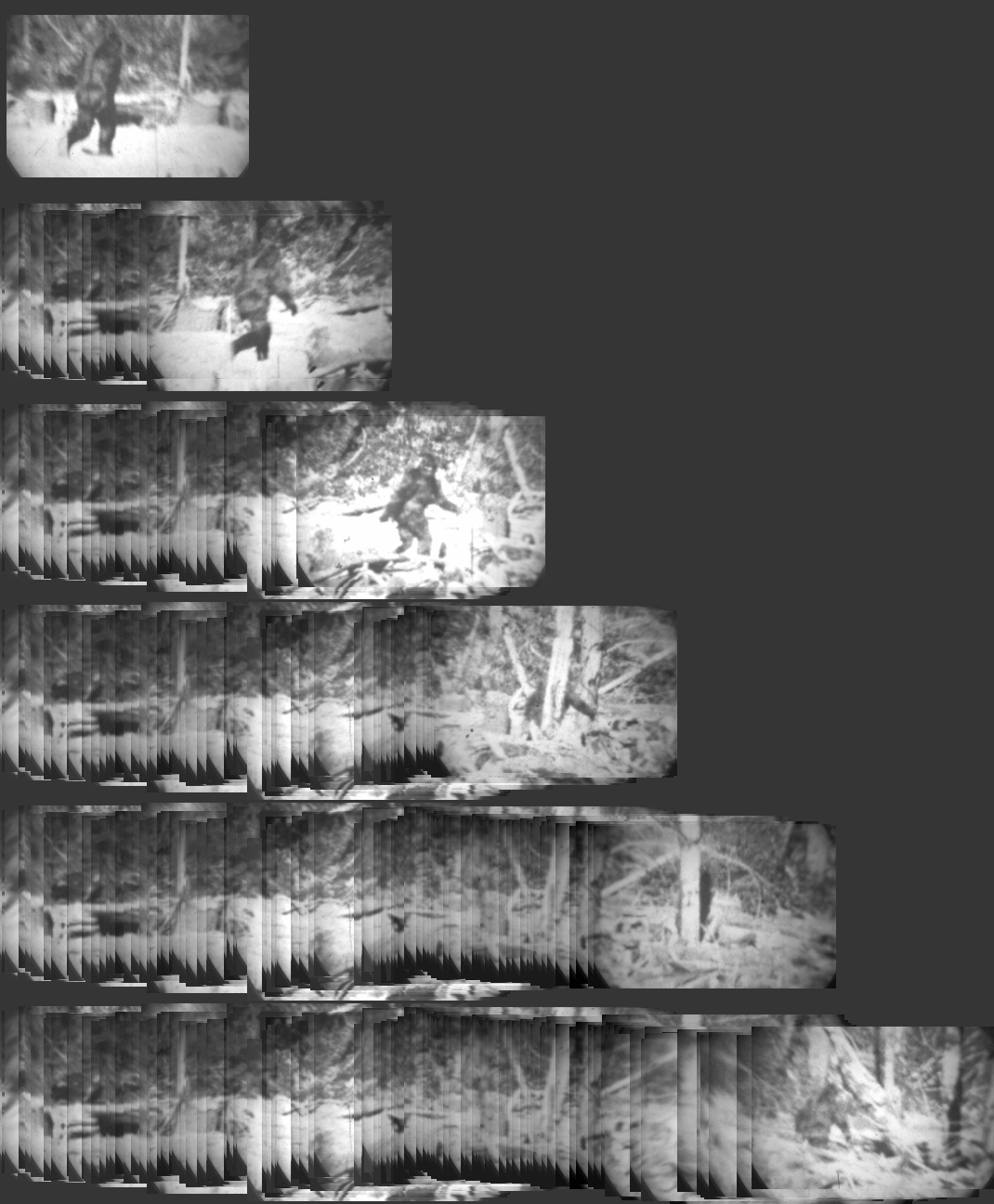
1. The Patterson-Gimlin Film (1967)

The Patterson-Gimlin film, recorded in Northern California’s Bluff Creek area on October 20, 1967, remains the most famous piece of Bigfoot footage ever captured.

The film appears to show a large, hair-covered creature walking through a clearing.

Supporters argue that the creature’s movement, anatomy, and proportions are difficult to explain as a person in a costume. Skeptics argue that the footage can be explained as a hoax.

The debate has continued for decades, including modern discussions about whether recreations of a person wearing a Bigfoot costume actually explain the original footage.

The article “Undebunking Bigfoot: Why Capturing Bigfoot Does NOT Debunk the Patterson-Gimlin Film” examines the argument that simply creating a Bigfoot costume or recreation does not necessarily explain every detail of the original film.

Source:
https://undebunkingbigfoot.blogspot.com/2026/03/why-capturing-bigfoot-does-not-debunk.html

Regardless of interpretation, the Patterson-Gimlin film remains one of the most analyzed pieces of cryptid evidence in history.


2. The 1958 Bluff Creek Footprints

In 1958, large footprints were discovered near Bluff Creek, California, by workers in a logging area.

Newspaper coverage of the tracks helped popularize the term “Bigfoot” and brought the subject into mainstream attention.

The footprints became one of the earliest widely reported examples of physical evidence associated with the modern Bigfoot phenomenon.

Sources:

  • Newspaper archives from 1958

  • Historical Bigfoot research collections


3. The FBI Examination of Bigfoot Hair Evidence (1976)

In 1976, the FBI examined hair samples submitted by Bigfoot researcher Peter Byrne.

The agency conducted laboratory testing, including microscopic analysis. The FBI concluded the sample was consistent with deer hair and found no evidence identifying it as belonging to an unknown primate.

The case is notable because it demonstrates that a government agency did examine Bigfoot-related evidence.

Source:
FBI Vault — Bigfoot File

https://vault.fbi.gov/bigfoot


4. Government Records and Bigfoot Recognition

Bigfoot has appeared in official government records, particularly at local levels.

In 1969, Skamania County, Washington, passed legislation related to protecting Bigfoot. The measure reflected the large number of reports in the area and the creature’s cultural importance to the region.

While these actions are sometimes described as symbolic or connected to local culture and tourism, the documents themselves are real government records that directly reference Bigfoot.

Supporters point to these examples as evidence that the phenomenon has been taken seriously enough to enter official discussions. Critics point out that recognition or protection does not constitute scientific confirmation.

Sources:

  • Skamania County historical records

  • Local government archives


5. Bigfoot as Part of Public Lands and Regional Culture

Bigfoot has become more than just a mystery — it has become part of the cultural identity of many areas where sightings are frequently reported.

Across the country, forests, parks, museums, gift shops, and tourism organizations have incorporated Sasquatch into their local storytelling.

For example, visitors to areas connected to the Allegheny National Forest in Pennsylvania may encounter Bigfoot-themed items such as Sasquatch field guides, magnets, and other merchandise connected to local folklore.

These displays and products are not scientific confirmation that Bigfoot exists. However, they demonstrate something interesting: the Bigfoot phenomenon has become a recognized part of the public conversation surrounding wilderness, exploration, and local history.

In many communities, Bigfoot represents the idea that there may still be mysteries hidden in the natural world.

The distinction is important: a public agency, park, or tourism organization featuring Bigfoot does not prove the existence of the creature, but it does show how deeply the legend has become connected to certain places and communities.

Sources:

  • Allegheny National Forest visitor materials and gift shop observations

  • Local tourism resources from regions associated with Bigfoot folklore


6. The Freeman Footage (1994)

Bigfoot researcher Paul Freeman recorded footage in Washington State in 1994 that he claimed showed a Sasquatch.

The footage remains controversial. Supporters argue it shows a naturally moving creature, while skeptics suggest alternative explanations.

Like many famous Bigfoot cases, the debate continues because different researchers interpret the evidence differently.

Sources:

  • Bigfoot research archives

  • Independent analyses of the footage


7. The Sierra Sounds (1970s)

The Sierra Sounds are audio recordings made by Bigfoot researchers in the California Sierra Nevada mountains.

The recordings contain unusual vocalizations that some researchers believe may represent unknown animals.

Others have suggested possible human or known-animal explanations.

The recordings remain one of the better-known examples of claimed Bigfoot audio evidence.

Sources:

  • Bigfoot research publications

  • Audio analysis discussions


8. Thousands of Reported Sightings

The Bigfoot phenomenon includes thousands of reported sightings from across North America.

Witnesses include hikers, hunters, outdoorsmen, law enforcement officers, and ordinary people.

Eyewitness accounts alone cannot confirm the existence of a species, but researchers argue that the consistency of some reports across decades is one reason the subject continues to receive attention.

Source:
Bigfoot Field Researchers Organization (BFRO) sighting database

https://www.bfro.net/


9. Indigenous Traditions and Older Stories

Stories of wild, human-like beings appear in many Indigenous traditions across North America.

These traditions vary widely between cultures and existed long before the modern “Bigfoot” name became popular.

Researchers study these accounts as part of the broader history of human encounters with mysterious forest beings.

Sources:

  • Anthropological studies

  • Indigenous folklore research


10. Modern Bigfoot Research

Today, some researchers use methods similar to wildlife studies, including trail cameras, audio recording equipment, footprint documentation, and environmental surveys.

Organizations such as the Olympic Project have conducted long-term investigations in areas with repeated reports.

These efforts have not produced universally accepted scientific proof, but they demonstrate that the search continues using modern tools.

Source:
Olympic Project

https://www.olympicproject.com/


11. The Scientific Question Remains Open

The biggest question surrounding Bigfoot remains simple:

If a large unknown primate exists in North America, where is the physical evidence?

Scientists generally require evidence such as DNA, bones, a specimen, or other verifiable biological material before accepting a new species.

At the same time, supporters argue that the number of reports, recordings, investigations, and historical records justify continued study.


Final Thoughts

Bigfoot remains one of the world’s most famous mysteries because it combines wilderness exploration, eyewitness testimony, cultural history, and scientific questions.

Some cases have possible explanations. Others remain debated.

The most productive approach is the same used in any investigation: examine the evidence, separate confirmed facts from interpretation, and continue searching for answers.

Whether Bigfoot turns out to be an undiscovered animal, a cultural legend, or something else entirely, the mystery itself has become an important part of modern folklore.

Additional Sources

  • FBI Vault: Bigfoot File

  • Bigfoot Field Researchers Organization (BFRO)

  • Skamania County historical records

  • Historical newspaper archives

  • Patterson-Gimlin film research archives

  • Olympic Project research materials

Could Bigfoot Be Dangerous? Examining the Overlooked Question of Sasquatch Behavior

Could Bigfoot Be Dangerous? Examining the Overlooked Question of Sasquatch Behavior

When most people picture Bigfoot, they imagine a gentle giant.

Popular culture has transformed Sasquatch into a misunderstood forest creature — a shy being that avoids humans and wants nothing to do with conflict. From movies to documentaries, the modern image is often closer to a friendly neighbor in the woods than a wild animal.

But there is a question that is rarely examined:

If Bigfoot were a real species, would it necessarily be harmless?

The question is not whether Bigfoot is “good” or “evil.” The question is whether an unknown animal should automatically be assumed to behave differently from every other large creature on Earth.

If Sasquatch existed, it would likely have instincts, territorial behaviors, individual personalities, and survival needs just like other animals.

The Friendly Bigfoot Problem

The popular image of Bigfoot is often influenced by entertainment. Movies such as Harry and the Hendersons helped create the idea of Sasquatch as a gentle, misunderstood creature.

But a fictional portrayal is not the same thing as a biological assessment.

If Sasquatch were real, it would not necessarily fit into a simple category of “friendly” or “dangerous.” Nature is more complicated than that.

Among known species, individuals can vary greatly. Some animals are curious. Some are fearful. Some are territorial. Some are aggressive when threatened.

Humans themselves demonstrate this variation.

If Sasquatch were a real intelligent species, it would be reasonable to ask whether the same variation could exist among them.

“No Credible Reports” — A Question of Definition

A common statement in Bigfoot discussions is that there are “no credible reports” of Bigfoot harming humans.

That statement deserves examination because the word “credible” carries a lot of weight.

It does not mean there are no stories.

It means that the person evaluating those stories does not consider them reliable enough to accept as evidence.

This raises an important question:

Who decides what is credible?

Different researchers may evaluate the same account differently. One person may see a story as folklore, while another may see it as a report worth investigating.

The existence of disputed accounts does not prove they happened, but dismissing them completely may prevent meaningful discussion about possible behavior.

Traditional Stories of Dangerous Sasquatch-Like Beings

The modern friendly Bigfoot image is only one interpretation of these beings.

Long before the word “Bigfoot” became popular, many Indigenous cultures had traditions involving large, hairy, human-like beings.

These stories vary greatly between cultures. Some describe beings that are mysterious or reclusive. Others include warnings about powerful or dangerous entities.

Some traditions discussed by Bigfoot researchers include accounts of Sasquatch-like beings carrying away people, including stories involving women being taken.

These accounts should be understood as traditional stories and oral histories rather than confirmed events. However, they demonstrate that the idea of these beings has not always been limited to a harmless creature hiding in the forest.

The older traditions are often much more complex than the modern popular image.

The Dennis Martin Disappearance and Missing 411 Discussions

One of the most discussed Missing 411 cases connected to Bigfoot theories is the 1969 disappearance of six-year-old Dennis Martin in the Great Smoky Mountains.

David Paulides has discussed the case through his Missing 411 research, but he has not claimed that Bigfoot was responsible.

The reason the case enters Bigfoot discussions is because of witness accounts describing a large figure carrying something over its shoulder. Some researchers have interpreted this description as possibly resembling a large hairy creature carrying the child.

Others have suggested different explanations.

The importance of the case is not that it proves a Sasquatch connection. Rather, it demonstrates how some researchers arrive at the question in the first place.

The Stacy Aris Disappearance

Another case sometimes discussed in connection with Bigfoot theories is the 1981 disappearance of 14-year-old Stacy Aris in Yosemite National Park.

Stacy disappeared while hiking near the Sunrise High Sierra Camp. Despite extensive searches involving rescue teams, volunteers, helicopters, and search dogs, no confirmed trace of her was ever found.

David Paulides has discussed the case but has not claimed Bigfoot involvement.

Some researchers and commentators have connected the case to Sasquatch discussions because of the remote wilderness location, the lack of evidence, and the broader history of unusual reports from wilderness areas.

The most commonly considered explanation is that Stacy suffered an accident in difficult terrain and was never found.

The Bigfoot connection remains speculative, but the case is often included in discussions about unexplained wilderness disappearances.

Ape Canyon: A Classic Story of Aggressive Behavior

One of the most famous examples cited in discussions of potentially aggressive Bigfoot behavior is the 1924 Ape Canyon incident near Mount St. Helens, Washington.

According to the accounts of several miners, they encountered large, hairy, ape-like creatures and later claimed their cabin was attacked during the night by beings throwing rocks and boulders.

The story became one of the earliest and most famous Bigfoot-related reports involving alleged aggression.

Critics have questioned the details of the account and offered alternative explanations. However, within Bigfoot research, Ape Canyon remains an important example because it describes behavior that witnesses interpreted as defensive or territorial.

If the event happened as described, it would represent a very different image from the harmless Bigfoot often portrayed today.

Portlock, Alaska: The Legend of the Killer Sasquatch

Perhaps the most famous modern story involving a dangerous Sasquatch comes from Portlock, Alaska.

According to local legend, residents of the remote settlement experienced frightening encounters with a large, hairy unknown creature known in some accounts as the Nantinaq.

Stories claim that people disappeared, strange tracks were found, and fear of the creature eventually contributed to the community being abandoned.

The story was investigated in the television program Alaskan Killer Bigfoot, which explored the Portlock legend and reported encounters connected to the area.

However, the details remain debated. Some researchers believe later retellings exaggerated parts of the story, and the decline of the community may have involved other factors.

Regardless, the legend remains one of the most commonly cited examples in discussions about whether Sasquatch could potentially be dangerous.

The Dog Question: Would Sasquatch Interact Aggressively With Animals?

Another recurring theme in Bigfoot reports involves encounters with dogs.

Some accounts describe dogs reacting fearfully to a Sasquatch presence, while others describe alleged attacks or injuries involving dogs.

Reports of aggressive encounters with dogs are controversial and difficult to verify, but they raise an interesting behavioral question.

If Sasquatch were a real animal, interaction with dogs would not be unusual.

Dogs are territorial animals. They are closely related to wolves and coyotes, and they often react strongly to unfamiliar animals entering their environment.

A large unknown primate might ignore dogs, avoid them, or potentially view them as a threat.

Reports involving dogs are inconsistent, with some claiming aggression and others describing peaceful encounters.

That inconsistency may actually fit the behavior of a complex species.

A Real Species Would Not Be One-Dimensional

The biggest question is this:

If Sasquatch existed, why would we assume every individual would behave the same way?

Every known species has variation.

Some individuals are calm. Some are aggressive. Some are curious. Some are territorial.

Even highly intelligent animals display a wide range of behaviors.

A real undiscovered species would not necessarily be a monster — but it also would not necessarily be a harmless cartoon character.

The responsible approach would be to examine all possibilities.

The Real Mystery

The question of whether Bigfoot could be dangerous is not about creating fear.

It is about consistency.

If Sasquatch is discussed as a possible animal, then it should be considered through the same lens as other animals.

That means asking:

Would it have instincts?
Would it defend territory?
Would individuals behave differently?
Could some encounters be dangerous?

The mystery of Bigfoot continues because so much remains unknown.

Perhaps the biggest mistake would be assuming we already know what an unknown creature would be like.