10 of the Most Interesting Historical Bigfoot Reports
Bigfoot is usually thought of as a modern mystery—something that emerged in the forests of the Pacific Northwest during the twentieth century. But stories of large, hairy, humanlike creatures in the wilderness go back much further.
Some of these reports are probably folklore. Some may involve bears or other animals. A few appear to have been outright hoaxes. And then there are cases that remain genuinely difficult to explain.
That doesn't mean any of them prove that Bigfoot exists. But taken together, they make for a fascinating piece of North American history.
Here are ten of the most interesting.
1. Bauman's "Wild Beast" — Montana, 1860s
One of the earliest famous American accounts comes not from a Bigfoot hunter, but from Theodore Roosevelt.
In The Wilderness Hunter, published in 1893, Roosevelt described a story told to him by an old mountain hunter named Bauman. Years earlier, Bauman and a trapping companion had camped in a remote region of what is now southwestern Montana.
They discovered strange tracks that appeared to have been made by something walking on two feet. That night, Bauman awoke to the smell of a powerful wild animal and saw a large figure at the entrance to their shelter. He fired at it, but the creature disappeared into the forest.
The next day, the men discovered that their camp had been disturbed. When they returned later, their shelter had been torn apart again.
The story is intriguing because Roosevelt himself was not necessarily convinced that Bauman had encountered anything supernatural. He suggested that fear and the circumstances might have caused Bauman to interpret an unusually dangerous animal as something more mysterious.
That ambiguity is exactly what makes the story interesting.
It is an early example of a recurring Bigfoot theme: strange tracks, a powerful odor, a large upright figure and an encounter in deep wilderness.
2. The Jacko Story — British Columbia, 1884
This one is fascinating for an entirely different reason.
In July 1884, a British Columbia newspaper reported that a strange creature had supposedly been captured near Yale. The creature, nicknamed "Jacko," was described as being about four and a half feet tall, covered in dark hair and possessing remarkable strength.
The story sounds remarkably like the sort of thing that would later be classified as a Sasquatch.
There's just one problem.
Other newspapers quickly investigated the claim and reported that no such creature had actually been captured. One contemporary newspaper called the story essentially absurd, while another reported that people had gone to the local jail expecting to see the creature and found nothing but the jailer.
So Jacko is almost certainly not evidence of a captured Bigfoot.
But historically, it's fascinating because it demonstrates that stories about mysterious hairy humanlike creatures were circulating in British Columbia long before the modern Bigfoot craze. It also demonstrates something else important: nineteenth-century newspapers could publish extraordinary stories that turned out to be questionable or false.
Jacko is therefore both a Bigfoot story and a lesson in how legends are created.
3. The Ape Canyon Attack — Mount St. Helens, 1924
This may be the greatest old-fashioned Bigfoot story of them all.
In July 1924, several prospectors working near Mount St. Helens in Washington said they encountered large, hairy, humanlike creatures. According to their account, the creatures later attacked their cabin during the night, throwing rocks and attempting to get inside.
The men claimed they had previously seen enormous footprints and had even fired at one of the creatures.
The story became a sensation, and the location eventually became known as Ape Canyon.
There is, however, a major problem for the believers: Forest Service rangers investigated the site and reportedly found no body or other conclusive evidence. They also demonstrated that some of the footprints could have been fabricated.
So was it a genuine encounter, an exaggerated encounter, or an elaborate prank?
We don't know.
What makes Ape Canyon historically important is that it became one of the foundational modern American "wild man" stories decades before the word Bigfoot became famous.
4. The Albert Ostman Abduction — British Columbia, 1924
The same year as Ape Canyon produced another extraordinary report.
Canadian prospector Albert Ostman later claimed that, while camping near Toba Inlet in British Columbia, he was picked up—sleeping bag and all—and carried away by a Sasquatch.
According to Ostman, he was held for approximately six days by what he described as a family group: a large male, a female and two younger creatures.
Eventually, he escaped.
The remarkable thing about the story is its detail. Ostman described the creatures' appearance, behavior and interactions with one another.
But there's a huge caveat: he didn't publicly tell the story until 1957, more than three decades after the alleged event. Researchers have therefore wondered whether later Bigfoot stories may have influenced his recollection.
That doesn't prove Ostman invented it. But it makes the story considerably harder to evaluate.
Either way, it remains one of the strangest Bigfoot narratives ever reported.
5. The Ruby Creek Encounter — British Columbia, 1941
In September 1941, Jeannie Chapman and her children were living near Ruby Creek, British Columbia, when they reportedly encountered a huge hairy creature in broad daylight.
At first, Chapman thought she was looking at a bear.
Then it stood upright.
She described it as approximately seven and a half feet tall, enormously broad through the chest, with long arms, a relatively small head and hair covering its body.
The family fled.
Afterward, large humanlike footprints were reportedly discovered around the property, and the creature was said to have returned repeatedly over the following days.
This case is particularly interesting because it wasn't simply a story about something seen fleetingly in the woods. There was a family of witnesses, a relatively close-range observation and reports of tracks around the home.
On the other hand, the physical evidence was never preserved in a way that could settle the question scientifically.
Ruby Creek therefore sits in that interesting middle ground: much more substantial than a campfire story, but nowhere near enough to establish the existence of an unknown primate.
6. The William Roe Encounter — British Columbia, 1955
If you're looking for a classic eyewitness report, William Roe's encounter is hard to beat.
In October 1955, Roe reportedly encountered a large, hairy, humanlike creature near Mica Mountain in British Columbia.
What makes the account unusual is the amount of detail.
Roe said the creature initially appeared to him to be a grizzly bear. When it stood up, however, he realized that it didn't look like a bear at all. He observed it for an extended period from relatively close range.
He described its anatomy, movements, eating behavior and reactions to him.
At one point, Roe reportedly had his rifle trained on the creature but decided not to shoot because he believed it might actually be some kind of human being.
Roe later provided a detailed sworn account.
Again, this isn't proof. An eyewitness can be mistaken, and memories can change.
But the Roe case is interesting because it isn't dependent on a three-second glimpse through trees. It is an unusually detailed observation of something the witness believed was neither human nor any known animal.
7. The Jerry Crew Footprints — California, 1958
This is the case that effectively gave Bigfoot his modern name.
In 1958, bulldozer operator Jerry Crew was working on a logging road near Bluff Creek in Northern California when enormous humanlike footprints began appearing around the construction site.
The prints were approximately 16 inches long.
Crew eventually made plaster casts of them and took one to the Humboldt Times in Eureka.
Newspaper reporter Andrew Genzoli wrote about the mystery, using the workers' nickname for the supposed creature: "Bigfoot."
The story went national.
There's an important twist, though. Decades later, the family of local logger Ray Wallace claimed that Wallace had been responsible for making the footprints with carved wooden feet.
That revelation casts a long shadow over the 1958 tracks.
Nevertheless, the historical significance is undeniable. Whatever actually made those footprints, this was the episode that helped transform scattered "wild man" stories into the modern American Bigfoot phenomenon.
8. The Laird Meadow Tracks — California, 1963
Three decades after Ape Canyon and several years after the first famous Bluff Creek tracks, another remarkable trackway appeared in Northern California.
In October 1963, large footprints were reportedly discovered at Laird Meadow in the Bluff Creek region. Some measured roughly 17 inches long.
Roger Patterson—who would later make the famous Patterson-Gimlin film—eventually obtained information about the tracks and made casts.
The Laird Meadow case is interesting because it forms part of a larger pattern of reported tracks in the region rather than standing completely alone.
Skeptics can reasonably ask whether people were becoming increasingly primed to interpret unusual tracks as Bigfoot tracks. Believers can point to the number of reported trackways over the years.
Neither side gets a knockout punch from the evidence.
But historically, Laird Meadow is an important chapter in the buildup to 1967.
9. The Patterson-Gimlin Film — California, 1967
And now we arrive at the granddaddy of them all.
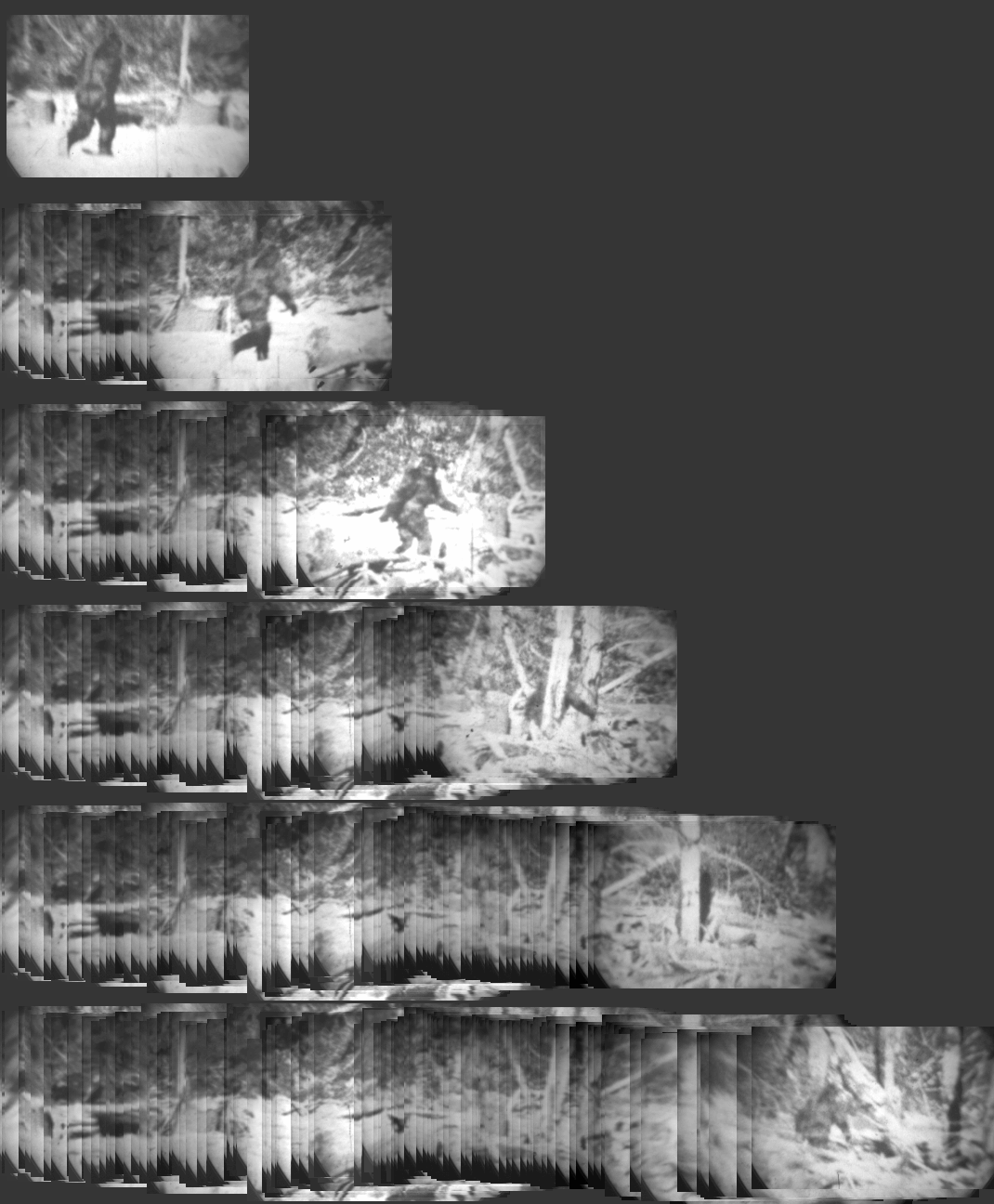
On October 20, 1967, Roger Patterson and Bob Gimlin were riding along Bluff Creek in Northern California when they said they encountered a large, hairy, humanlike creature. Patterson filmed it.
The resulting footage lasts less than a minute.
The figure—often called "Patty"—walks away from the two men and occasionally looks back toward them. For decades, the film has been presented as the strongest visual evidence that Bigfoot might actually exist.
But there has been considerable controversy over the film, including detailed arguments that the footage depicts a person in a costume rather than an unknown primate. The subject deserves more serious examination than simply labeling the film either "proof" or an obvious hoax.
One particularly worthwhile resource is Bigfoot Times, which has done extensive coverage of the Patterson-Gimlin controversy, including arguments and evidence challenging the film's authenticity.
For readers who want to dig much deeper into the subject, Daniel Perez is also the author of Bigfoot at Bluff Creek: A Pictorial Discussion, an excellent resource devoted to the Bluff Creek story and the Patterson-Gimlin film.
I also had the opportunity to interview Daniel Perez for my own site, and that interview is well worth reading for anyone interested in his research and perspective on the subject:
Interview with Bigfoot Times Newsletter Creator Daniel Perez
The Patterson-Gimlin film remains historically important regardless of what one ultimately thinks is walking across that California sandbar. It became the defining piece of visual evidence in the Bigfoot story—and, precisely because it is so famous, it has also become one of the most intensely scrutinized.
For anyone seriously interested in Bigfoot history, the film is worth studying from both sides of the controversy rather than simply accepting the traditional claim that it is either definitive proof or an obvious hoax.
10. The Strange Reports Before Bigfoot Had a Name
Perhaps the most interesting "report" isn't one particular encounter at all.
It's the enormous collection of older stories about wild, hairy, humanlike beings that existed before the modern word Bigfoot appeared.
Indigenous traditions throughout the Pacific Northwest contain accounts of wild or supernatural forest beings, although it is important not to casually assume that every traditional figure was simply a description of Bigfoot. These traditions have their own cultural meanings and histories.
European settlers and later frontiersmen also produced scattered accounts of "wild men," strange tracks and hairy creatures.
Then, in the nineteenth and early twentieth centuries, newspapers began publishing stories about mysterious creatures in British Columbia, Washington, Oregon and California.
By the time the 1950s arrived, there was already a substantial cultural tradition waiting for a name.
Then came Bluff Creek.
And the name Bigfoot stuck.
That may be the most important historical mystery of all: not whether one particular story can be proven, but why a remarkably persistent idea keeps appearing in different times and places.
So What Do These Stories Actually Tell Us?
Not that Bigfoot has been proven.
They don't.
Some of these cases have serious problems. Jacko appears to have been a hoax. The 1958 Bluff Creek footprints may have been a prank. Ape Canyon has substantial reasons for skepticism. And the Patterson-Gimlin film remains controversial.
But dismissing everything as "people seeing bears" doesn't quite capture the historical record either.
There are decades of reports from people who claimed to have encountered something large, hairy and humanlike—and some of the witnesses provided remarkably consistent descriptions.
The real mystery is therefore a little more interesting than "Is Bigfoot real?"
It's this:
Why has the Bigfoot phenomenon persisted for so long, across generations, cultures and regions—and what combination of folklore, misidentification, hoaxes, expectation and perhaps genuinely unexplained encounters created the legend we have today?
That is a much harder question.
And, in my opinion, a much more interesting one.

