Posted by: Craig Woolheater on January 18th, 2006
Published on LiveScience.com today is an article written by a Cryptomundo commenter, Benjamin Radford, editor of the
Skeptical Inquirer, entitled, "
Rare Woodpecker Search Sheds Light on Bigfoot." Going to the site, I found it humorous that the ad for the page is the Canadian Sasquatch for the Discovery Channel’s show "
Mythbusters."
Some of what is included in Mr. Radford’s article has been
discussed here on Cryptomundo in the past.
Read the article on the LiveScience.com website, then read our
rebuttal below and offer your thoughts and comments. Hopefully Mr.
Radford will join us here for this discussion.
Pseudo-logic ( sū ‘ dō-lŏ’ jək) n. A system of
deduction that initially appears to be based in solid inferential
reasoning, but upon closer examination is determined to actually be
without logical foundation.
Initially, the position staked out here by Benjamin Radford appears
to have a logical foundation. He asserts that when a well-equipped team
of professional and amateur scientists conducts a field study in the
woods of rural Arkansas, and reports no sightings of the undocumented
creature referred to as “bigfoot,” that it somehow validates or
strengthens the position of those who claim that the animal does not
exist.
Come again?
Actually, hundreds of excursions across North America take place
every year by groups and individuals who fail to mention sightings of
large, bipedal, hair-covered primates. However, Mr. Radford also seems
to be ignorant of incursions into the American outback by groups and
individuals who do report sightings of large, bipedal, hair-covered
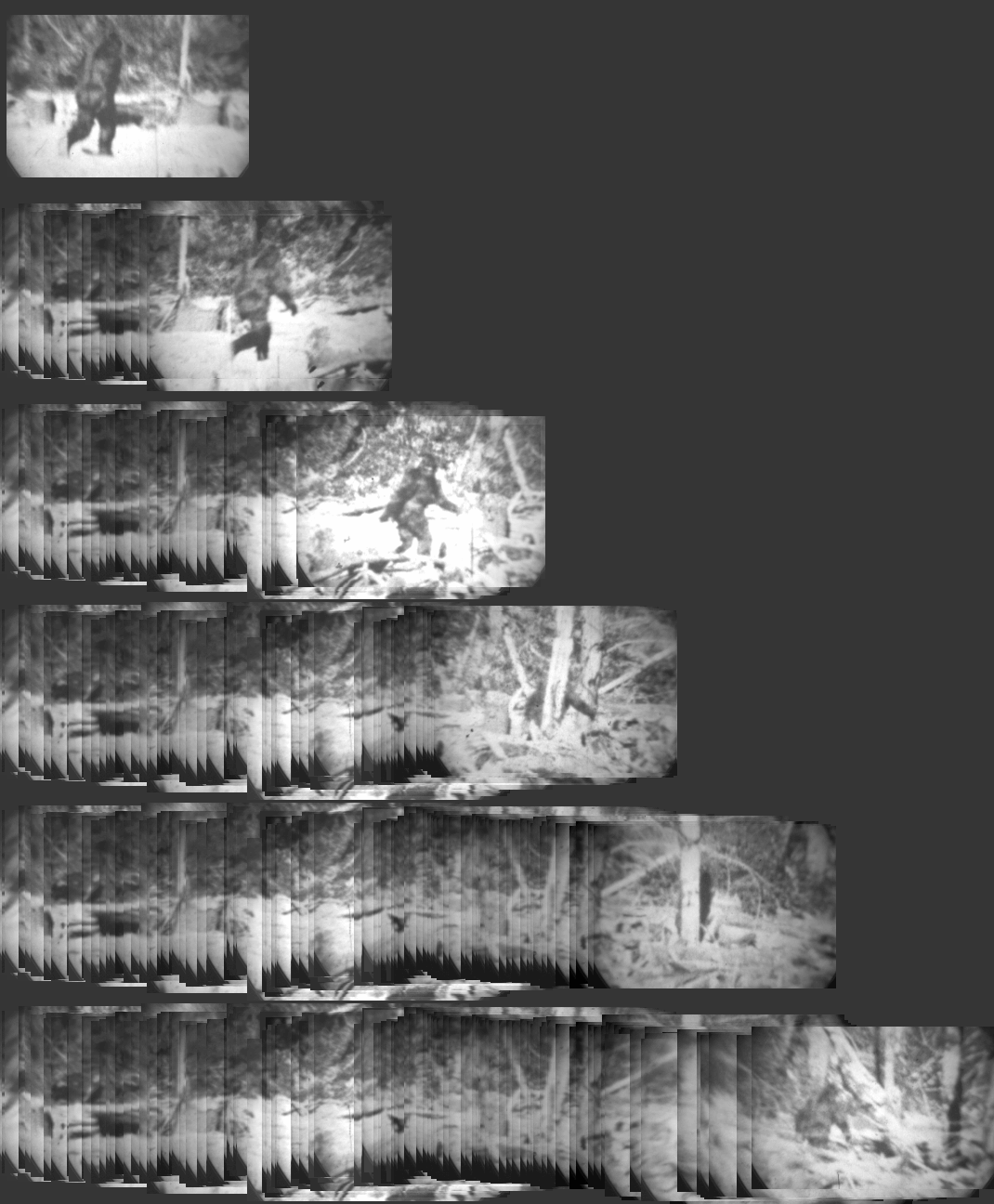
primates. In fact, one month-long expedition in 1967 even yielded film
footage of what is possibly the animal Mr. Radford says doesn’t exist.
Mr. Radford seems to imply that simply because the well-equipped team
who rediscovered the Ivory-billed Woodpecker wasn’t actually looking
for large, unknown, bipedal apes, that if they reported a sighting, the
sighting would somehow have some special merit that sighting reports by
others in the past do not have. After all, the Ivory-billed Woodpecker
researchers included biologists from Cornell University, as well as
quite a few volunteer part-time field assistants. So, what if the team
had reported a sighting of a sasquatch or recorded some primate-like
vocalizations while out in the field? Would it have given Mr. Radford
and others like him cause for consideration regarding the matter of
bigfoot?
There
are teams of professional and amateur scientists who
have reported such encounters (including the
Texas Bigfoot Research Center,
a network of amateur and professional scientists dedicated to
investigating the sasquatch mystery in Texas, Oklahoma, Arkansas and
Louisiana), and there are individuals who happen to be anthropologists,
wildlife biologists, psychologists, law enforcement and forest service
professionals who have reported sightings, but apparently Mr. Radford
and others like him simply choose to sweep such reports aside, citing
wishful-thinking, misidentification and hallucination as the cause of
such reports.
Interesting.
Apparently, what scientists
don’t see is more important to Mr. Radford and others like him, than what scientists
do see.
We also have many reports from hunters, who happen to be the most
prolific witnesses in terms of bigfoot encounters, resulting from their
sustained incursions into the remote and densely wooded areas said to be
the habitat of sasquatches. While their business in the American
wilderness is not of an investigatory nature, hunters are nevertheless
out there for prolonged periods. However, Mr. Radford refuses to
acknowledge the significance of their eyewitness reports.
Why is it that Mr. Radford seems to be more enamored with the fact that the Ivory-billed Woodpecker researchers
did not
report having sasquatch encounters than he is that large numbers of
American and Canadian hunters, in addition to groups of researchers,
comprised of amateur and professional scientists,
have reported such encounters?
Mr. Radford apparently dismisses many such sighting reports because
they, in his opinion, are from “believers” (which somehow invalidates
their findings). Apparently, Mr. Radford is very adept at overlooking or
ignoring important little facts. For example, many of the amateur and
professional scientists who have reported encounters were not
“believers” until they actually had the encounters; the vast majority of
the hunters and motorists who reported such encounters were not
“believers” at all until they actually saw something for which they had
no conventional explanation. So, just because they reported a sighting
(making them “believers”), are witnesses suddenly lacking credibility as
individuals and scientists?
There’s more to ponder:
It is likely that, given the probable rarity of the species, there
were no unknown North American apes in the area of southeastern Arkansas
where the Ivory-billed Woodpecker researchers were searching.
This brings up another question: Has Mr. Radford actually talked to
all the biologists and field assistants who were searching for the
“grail bird” regarding what they saw or heard?
Sixteen square miles is not a very large area. Although it would
certainly seem big to a person wandering around within it, it’s a drop
in the bucket in terms of available habitat. To assume that an animal
not observed within a prescribed area during a specific time frame must
not exist anywhere is silly. How many mink did the biologists and
volunteers see in that area? River otters? Did they observe black bears?
Many woodpecker holes are constantly being monitored. Did the observers
see flying squirrels, common animals that live in tree cavities? How
many of these folks saw bobcats or gray foxes? All of these species
should be expected in the ivory-billed study area. By Mr. Radford’s
logic, if any of these species were not observed, they must be extinct.
Mr. Radford insinuates that the place where the woodpecker was
observed is a prime sasquatch area, but is it? When was the last time a
credible report emerged from that specific vicinity? The BFRO has posted
on their website only one report, in
Cleveland County,
of a regional bigfoot sighting. This is over 60 miles southwest of the
Big Woods of Arkansas. The Texas Bigfoot Research Center has not
received any reports, credible or not, from the area. Characterizing an
entire state as “prime Bigfoot territory” illustrates ignorance
regarding animal distribution patterns in general. When biologists say
that any mammal may be expected within a certain approximate area or
range, it does not mean that the species will be found everywhere within
that area; it may
possibly be found wherever suitable conditions are found within that area. The same holds true for the sasquatch.
The current well-publicized attempt to further document the Ivory-billed Woodpecker is only the late
st of such efforts over the years. This active species is very large,
diurnal, and quite noisy. Yet, the documentation effort, to this point,
has been a disappointment. How logical is it to conclude that a rare
nocturnal animal like the sasquatch, an animal the birders are likely
not even thinking about, does not exist if it’s not seen?
The extensive search for the Ivory-billed Woodpecker was conducted
almost entirely during daylight hours; no night vision or infrared
devices were employed. Most sasquatch researchers believe that their
quarry is primarily nocturnal because there are as many or more
sightings of sasquatches during the night than during the day; far fewer
humans are active at night than daytime, therefore, nocturnalism of the
animal is probable. Furthermore, there are very, very few reports of
diurnal bigfoot vocalizations. The vast majority of reports regarding
purported sasquatch vocalizations result from nighttime encounters.
The Ivory-billed Woodpecker researchers were not, in even the most
remote way, looking or listening for an unknown bipedal primate. If they
had recorded sasquatch vocalizations, it’s unlikely they would have
expended much effort pondering what they were hearing; their search was
for a large diurnal bird with a “kent” call. They were fixated on that,
during the day. However, even had they made such recordings, Mr. Radford
and others like him would most likely remain dismissive and cynical,
continually citing “no hard evidence.”
There also exists the extremely remote possibility that one or more of the Ivory-billed Woodpecker researchers
did
have some type of encounter, but like others before them, they
hesitated to report it. Few researchers would be brazen enough to risk
the loss of project funding, or risk their personal and professional
reputations, by coming back with anecdotal reports of sasquatch
encounters, exposing themselves to ridicule and insinuations from
Benjamin Radford and others like him that such sightings were caused by
wishful thinking and/or misidentifications.
Following the line of reasoning presented by Mr. Radford, the fact
that the TBRC and investigators such as Chester Moore and others have
not reported any Ivory-billed Woodpecker sightings in Ivory-billed
Woodpecker habitat areas, despite spending an exorbitant amount of time
in such places (like the Big Thicket in Southeast Texas), must in some
way invalidate the findings of the birders who obtained four seconds of
woodpecker footage and a couple of purported ivory-billed vocalizations.
Obviously, this is a conclusion that reasonable people would never seek
to assert, but it is tantamount to what Mr. Radford has written.
The Texas Bigfoot Research Center is not a group made up of
individuals who, on a whim or dream, choose to waste a huge amount of
time and finances, risking personal and professional reputations, to
validate an animal that can’t possibly exist. The Texas Bigfoot Research
Center continues to maintain that the body of contemporary sighting
reports, ecological patterns and relationships arising from the study of
those reports, the physical evidence that has accumulated during the
last fifty years, and
our own personal observations while in the field, all serve to indicate the existence of a living species that has yet to be documented.
This response was written by Daryl Colyer, Alton Higgins and Craig Woolheater of the Texas Bigfoot Research Center.
This post was written by
 Craig Woolheater
 – who has written
1833 posts on
Cryptomundo.
Co-founder of Cryptomundo in 2005.
I have appeared in or contributed to the following TV programs, documentaries and films:
OLN's
Mysterious Encounters: "Caddo Critter",
Southern Fried Bigfoot, Travel Channel's
Weird Travels: "Bigfoot", History Channel's
MonsterQuest: "Swamp Stalker",
The Wild Man of the Navidad
Source: